
Insulin Resistance: The Hidden Metabolic Driver Behind Weight Gain, Fatigue, Brain Fog, and Chronic Disease
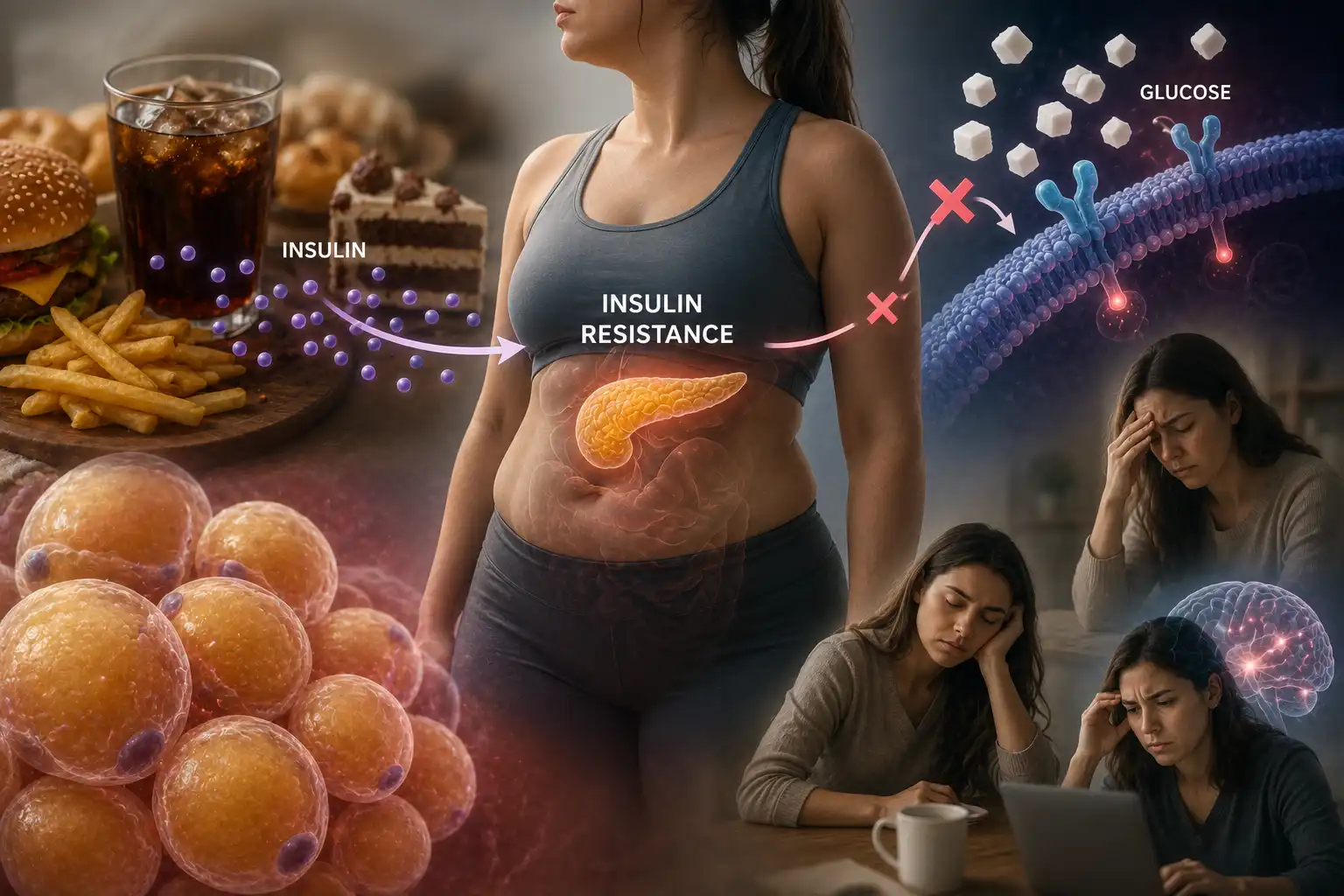
Insulin resistance is arguably the most consequential undiagnosed medical condition in the United States. Affecting an estimated 88 million Americans — over a third of the adult population — it operates silently for years before fasting glucose rises enough to trigger a prediabetes diagnosis. In the interim, it drives weight gain that resists dietary intervention, fatigue that sleep doesn’t fix, brain fog, cardiovascular disease risk, hormonal disruption, and a state of chronic inflammation that accelerates aging and disease. And it almost never appears on a standard blood panel.
What Insulin Resistance Actually Is
Insulin is the hormone secreted by the pancreas in response to rising blood glucose. Its primary role is to facilitate glucose entry into cells for energy production. In insulin resistance, cells in the liver, muscle, and adipose tissue become less responsive to insulin’s signal — requiring the pancreas to produce increasingly large amounts of insulin to maintain normal blood glucose. This compensatory hyperinsulinemia is the problem: chronically elevated insulin drives fat storage, inflammation, hormonal disruption, and cell damage throughout the body.
Why Standard Testing Misses Insulin Resistance
A standard metabolic panel includes fasting glucose — but not fasting insulin. This is like measuring the end product of a manufacturing process while ignoring whether the factory is running at double capacity to produce it. Fasting glucose remains “normal” for years, even decades, while the pancreas works progressively harder to maintain it.
The HOMA-IR: The Test That Should Be Standard
HOMA-IR (Homeostatic Model Assessment of Insulin Resistance) is calculated from fasting glucose and fasting insulin and provides a direct quantification of insulin resistance. A HOMA-IR below 1.5 indicates insulin sensitivity; above 2.5 indicates significant resistance. This test costs very little to add to a metabolic panel and would catch insulin resistance years before fasting glucose rises — but it is virtually never ordered in standard care.
How Insulin Resistance Drives Your Symptoms
Weight Gain and Resistance to Fat Loss
Chronically elevated insulin directly suppresses lipolysis — the release of stored fat for energy. The body cannot access its fat stores when insulin is elevated, creating a metabolic trap: hunger drives eating, but cellular energy production remains impaired because fat cannot be mobilized. Abdominal fat deposition is particularly promoted by insulin-cortisol interaction.
Brain Fog and Cognitive Impairment
The brain has insulin receptors throughout it, and insulin resistance in the brain — now termed “Type 3 diabetes” in Alzheimer’s research — impairs glucose metabolism in neurons, disrupts synaptic plasticity, and drives neuroinflammation. Brain fog is often one of the earliest and most distressing symptoms of insulin resistance, preceding obvious metabolic disease by years.
Hormonal Disruption
Insulin resistance disrupts virtually every hormonal axis. Elevated insulin promotes testosterone-to-estrogen conversion in adipose tissue (reducing testosterone in men). In women, insulin stimulates ovarian androgen production (driving PCOS). High insulin suppresses sex hormone binding globulin, altering free hormone availability. Cortisol promotes insulin resistance in a bidirectional relationship.
Cardiovascular Disease
Hyperinsulinemia promotes endothelial dysfunction, increases blood pressure through sodium retention and sympathetic nervous system activation, drives small dense LDL particle production (the most atherogenic lipoprotein fraction), and stimulates smooth muscle proliferation in arterial walls. The relationship between insulin resistance and cardiovascular disease predates the development of type 2 diabetes by decades.
The Functional Medicine Approach to Reversing Insulin Resistance
- Advanced metabolic testing: fasting insulin, HOMA-IR, fasting glucose, HbA1c, advanced lipids
- Dietary intervention: low-glycemic, ketogenic, carnivore, or time-restricted feeding based on individual metabolic profile
- Exercise prescription: resistance training is among the most potent insulin-sensitizing interventions available
- Sleep optimization: a single night of poor sleep measurably worsens insulin sensitivity
- Stress management: cortisol drives insulin resistance through gluconeogenesis and adipose mobilization
- Targeted supplementation: berberine, inositol, magnesium, chromium, alpha-lipoic acid
- Tirzepatide for patients where pharmacological support is clinically appropriate
- Regular monitoring: quarterly HOMA-IR and metabolic panel to track improvement objectively
| Insulin resistance is reversible — but only if it’s identified and addressed. Schedule a comprehensive metabolic evaluation with Dr. Johnny Gomes, DO, FAAEM, IFMCP at Optimal Health & Wellness. In-office or via telehealth across NC, TN, FL, GA, NJ, and PA. Call (828) 536-0320. |